Prenatal diagnostics helps to prevent the birth of children affected with genetic diseases to parents who belong to a high-risk group. Genetic tests are performed by removing a small sample of the placenta (chorionic villus sampling or CVS), or by amniocentesis. If an abnormality is found, he only option is to terminate the pregnancy.
Pre-implantation genetic diagnostics (PGD) is the earliest form of prenatal diagnostics as it involves the genetic testing of the pre-embryo before implantation, from the time of fertilization up to the blastocyst stage.
Thus, one of the advantages of PGD is that genetic abnormalities can be detected before pregnancy occurs, as only unaffected embryos are transferred to the uterus for implantation. According to the generally accepted position in the medical profession, PGD is recommended where couples are at risk of passing to the child so-called monogenically transmitted diseases, or there is an increased risk of numerical or structural chromosomal abnormalities.
Micromanipulator
A micromanipulator is used for the sophisticated intervention that involves the oocyte or the embryo. This device is capable of carrying out movements that the human hand is unable to execute. Micromanipulative techniques are used in the following areas:
- To assist fertilization: intracytoplasmic sperm injection (ICSI)
- Assisted hatching (AH): to improve implantation
- Sampling for pre-implantation genetic screening: polar body biopsy, blastomere biopsy, trophectoderm biopsy
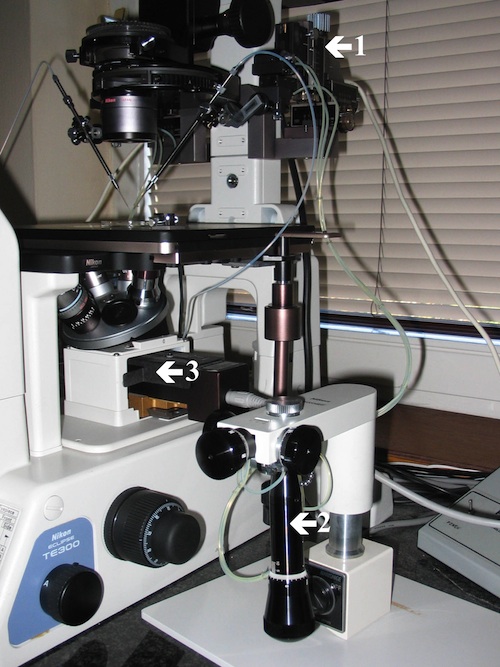
Micromanipulation system
1. Motor-drive course manipulator
2. Hydraulic joystick for fine manipulation (oil hydraulic)
3. Laser module for interventions involving the zona pellucida and/or embryonic cells